Sunday, November 15, 2009

Different ways to train Zhan Zhuang

There are many different ways for training Zhan Zhuang in different martial arts. Some focus more on imagination as a process for discovering the feeling, others more as a Zen meditation, and others still as an endurance or structural practice. There are many different flavors of Zhan Zhuang or standing meditation practices.

In Wujifa, (without going into the philosophy of the triangles) Zhan Zhuang is first practiced to discover structure, then connection. This is a very functional place to begin, as it calibrates the body and the mind to be able to work with more advanced practices.

In many martial arts, what is considered basic training in one art is considered to be the secrets in another. For example, one martial art may have the practitioner working with a weapon, because he’s not ready yet to engage in hand to hand combat. In another martial art, they might say the person’s not ready for a weapon until they can work empty-handed. In Wujifa, weapons are seen as an extension of the body, and/or tools for calibrating the structure.

Wujifa practice’s first focus is to get the body functional within a certain basic structure. When one first starts working with stance and structure, they may notice how the mind wanders, and the method of structure is a way of starting to engage intent of the alignment of the body. After one starts to make fascial connections and can maintain a good relaxed, balanced structure as an intention and as a physical practice, additional mental focuses can be engaged in a more practical way with the kinesthetic experience gained from practicing the structural intent.

The common mistake when people engage in various mental aspects is to only imagine leaving behind the function of structure. By focusing on the structure first, the imagined connections become less subjective in the sense that the physical responses of a connected aligned body will be verifiable. It is always important to verify the results one is getting lest one’s mind drift off into a fantasy world and that person becomes unable to produce any physical results or applications.

Another issue with many arts is only to work on the physical, and they forget to bring along the mind. We start by engaging the mind for the beginner in seeking the feeling. This feeling is the fundamental process of true Wujifa practice. Once one gets to this stage, noticing the intention and how this is engaged with the body takes one to the next level.

Also Read: A System of Martial Arts Training and Objectives for Wujifa

Saturday, October 31, 2009

A System of Martial Arts Training and Objectives for Wujifa

In the martial arts system of Wujifa there is a certain progression or evolution in the process of training. In the system of Wujifa, there are certain stages or steps that should be aimed for as one trains. When someone first starts training, working at understanding very basic “methods” or “forms” of method is key. These “methods”, like a finger pointing at the moon, are not about the “methods” or “finger”, but are more about the direction one will be heading in. Methods are much like a medicine and can assist or hinder one’s progress depending on the usage of various methods and when they are used.

People in Stance

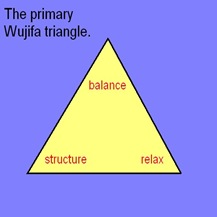
In the beginning, we start with 1234, 1234 (Zhan Zhuang Alignment). 1234, 1234 work with the structural aspect of the first Wujifa triangle. As  understanding the concepts of balance and relax are slightly more subjective concepts for the beginner, structure serves as a good starting point. As one gets a good feel for the method of 1234, 1234 we bring in the concepts of being balanced and relaxed within this structural foundation of the Wujifa martial arts and qigong training systems.

As one progresses and develops a deeper kinesthetic awareness for structure, balance and relax of the first Wujifa triangle1triangle the weight will start to sink and the new practitioner will find and become aware of the weight they have carried beginning to sink into the legs at a point in the center of the quadriceps. These are very good signs, and normally take anywhere from a few months to much longer depending on how seriously the practitioner trains. The aim is to stand for at least an hour one to two times a day. The Wujifa system is much like a doctoral program, and requires dedication by the practitioner to achieve these desired results.
At first, it is very common for people to find it very difficult to stand for even 10 minutes and that’s okay. Getting to the hour of stance, which is ultimately very important in the long run, can be accomplished by the method of slowly adding a few minutes every few days with the focus on the structural elements of 1234, 1234 and the more subjective meanings of balance and relax. When we say “subjective meanings”, we are talking about actual functional, physical results that are contributed to by the understanding of these kinesthetically experienced concepts.

The next step and objective in the martial arts training system of Wujifa is when the practitioner working with these concepts we’ve talked about begins to notice through sinking of the weight, the appearance of the fascial stretches. Commonly, these are noticed in the lower back. As talked about in other posts (The Concept of "Sit Down" in Wujifa Standing...), turning the femur heads out and relaxing the quadratus lumborum and other lower back muscles creates the space for this fascial system of the lower back to move into a more functional organization of one’s body . Training at this point creates the opportunity for the practitioner to begin to notice how the fascial system functions, and is noticed as what is commonly called in Wujifa “fascial stretch”.

At this point in Wujifa training, a practitioner is now getting a deeper understanding of the principles suggested in the first triangle of the Wujifa philosophy. Remember, the methods are not the truth. Understanding the principles and philosophies, through a kinesthetic awareness, are key to gaining this greater understanding of what balance, structure, and relax mean. As the student progresses and the body’s fascial systems open to a more functional organization, other fascial stretches are also noticed.

As one continues along this progression, the concept of connection starts to be explored. The practitioner’s goal at this point is to notice gaps between the fascial stretches by refining subtle adjustments within the philosophy of balance, structure and relax and the method of 1234, 1234 and adjusting accordingly to connect these fascial systems. This is the next step on the path of understanding internal strength, power, and movement.

Many times at this point, simple movements such as side to side (Keys for Developing the Inguinal Crease, aka Kua, with Wujifa Side to Side Practice ) have been introduced and contribute to the refinement of connection while moving and while standing. Also, it takes time for the body to adjust and strengthen these connections: it takes practice over time to develop these. For the serious practitioner, who puts in the time and effort, this can be accomplished in six months to a year from the previous step, and they begin to understand the meaning of the second triangle in the Wujifa system of connection, ease, and equilibrium.

At this point, the practitioner has come to have some skill and more advanced means of training are employed that continue to develop and refine these fascial system and connections. Working with gentle forms of resistance, light weights and partner practice have been introduced. At all times, the practitioner seeks opportunities for further refinement (gaps, breaks, and other areas) which they can gain insight from to help in their understanding of full-body movement and strength.

Now the practitioner is starting to gain some understanding of the third triangle of Wujifa which is Power, Poise, and Unity. Instead of practicing form, which can be limiting and slow the development in growth and understanding, the practitioner begins to analyze and 3 triangles 2 take more ownership, and seeks validation from someone who has skill in this area. Also the practitioner continues practicing and exploring the opportunities they are discovering within previous “basic” practices as well as developing unique methods for themselves by adding in free-form movements such as a slower form of solo combat dancing, increasing of weight bearing trainings while practicing for resistance, and issuing power by using heavy bags and sparring.

This system of objectives in Wujifa martial arts training above maps out the steps that the practitioner takes to gaining a more true understanding and skill of practice of what is called “Wujifa”. As one puts in the time and focuses not on problems, but what contributes to growth, while seeing the opportunities in the particular difficulties that might be perceived as holding them back, growth and progress within the system of Wujifa can be easily attained with dedication, attention, and focus.

For More Information on this subject these other articles may be very helpful to understand this topic in more detail:

Visit and Read: Zhan Zhuang Alignment

Visit and Read: Wujifa Triangles

Visit and Read: More on Zhan Zhuang and Movement

Thursday, October 29, 2009

Zhan Zhuang Alignment

When practicing Standing, or Zhan Zhuang, getting good alignment is one of the common difficulties for beginners. The method for Zhan Zhuang alignment in Wujifa is called “One Two Three Four, One Two Three Four”. The two sets of One Two Three Four are different and complementary sets of alignment points.

The first set of alignment points are: (these links open new windows)
2. The knees are over the feet.
3. The hip/inguinal crease/kua are lined up over the feet and knees.
4. The shoulders are lined up over the kua, or inguinal crease.

Looking at the foot first, draw a line from the center of the heel to the second or third toe. If we do this on each foot, these would be two parallel lines. This is what we mean by the feet are parallel. In this model, we extend these lines using visualization which will let us calibrate the accuracy of how parallel these lines truly are. Using these longer lines, small mis-calibrations will be easier to notice. It’s important to mention that the feet are only about a foot to a foot and a half apart. Many people stand with their feet much wider when standing. We will not address that method in this post.

Next, apply the same process to the knees. From the center of the knee cap to the center of the area on the back of the knee, we create two lines again and extend these visualized lines as we did with the feet. If the knees are turned out, the backs of the lines will intersect behind your body. If the knees are turned in, the fronts of the lines will intersect in front of your body. The aim is for the two lines to be parallel and over the two parallel lines of the feet.

The same method is applied to the hips from the center of the inguinal crease and center of each glute. If we tuck and tighten the glutes to pop the inguinal crease out in the front, the lines will intersect behind your body. If we tuck and crunch in the front with relaxed glutes, the lines will intersect in front of your body. (These are just two of many common misalignments.) Rolling the femurs out, relaxing the glutes, and relaxing the belly and lower back simultaneously corrects many common mistakes and will allow these visualized lines of the hips to be parallel, which will allow the parallel lines to stack up, over the knees and over the feet. If the lower back is arched, the lines in front of your body will be tilted down. If the lower back is tucked, then the visualized lines in front of your body will tilt up. What we seek is to have the visualized lines parallel and level with the ground and with each other.

For the shoulders, somewhere between the acupuncture points L1 and L2 and the outside of the shoulder is the point on the front (depending on the person) and the back point is relatively on the same area in the back. If people hunch forward, which is a common mistake, the extended visualized lines will intersect in the front. If the chest is puffed up with the shoulders pulled back using tension in the rhomboid and other upper back muscles, the lines will intersect behind you. Keeping the spine straight and allowing the rib heads to turn or relax naturally will allow the chest to relax and keep the shoulder lines parallel and over the hip, knee, and feet. This is the first set of alignment vectors.

The second One Two Three Four of basic standing Zhan Zhuang alignment consists of the following four points:

1. Inguinal crease "in"

2. Tailbone and lower back relaxed and sinking "downward"

3. With the spine straight and the rib heads relaxed, the sternum drops "downward" without hunching the back or shoulders.

4. The head relaxes "back and upward", maintaining a natural relaxed curve through the cervical vertebrae.

In the Wujifa system, we address the second model of One Two Three Four as puzzles. These puzzles are figured out over time through training.

The first puzzle that we normally address is the inguinal crease "in" and lower back/tailbone "down". This is different than tucking. As we’ve mentioned in other posts like "Basic Tips for Zhan Zhuang and the pelvis", and in the first model explained in this post, the femur heads roll out, creating a feeling of widening in the lower back, the glutes relax, and the lower back relaxes. This allows the inguinal creases to go in, the lower back to lengthen, and the tailbone to sink.

The next puzzle is the combination of points two and three. When the lower back sinks correctly, many people tend to hunch forward or lean backward. Keeping the spine straight and vertical and then allowing the rib heads to rotate is the key to understanding the relationship between points two and three, and is the aim of “Three” in this set and model.

In point number four (the head back and up), in connection with number three, many people pull the head forward, or back in a military “Attention” posture both which make the neck rigid. We correct this common problem by guiding them to straighten and elongate their spine by relaxing. Next we have them look up to the ceiling, and then bring their chin down by allowing the head to pivot on the top of the axis bone at the pinnacle of the spine. This results in the ears lining up over the shoulders in a natural way. Using this method allows a person to understand what is meant by the head back and up in a relaxed natural way.

An important point to remember is not to force this alignment. Some people have hunched for many years or stood with their feet turned out for many years, or have carried a lot of back tension for a long time, thereby shortening muscles in those respective areas. The mistake is to force this alignment instead of relaxing into it. So we bring the alignment as close as we can, challenging ourselves slightly so the muscles can relax and open in the problem areas. As we practice over time, we continue to adjust the parallel lines to where they will stack naturally and create better connections throughout the fascial systems of the body.

As one understands this more, one also understands how the method is not the truth, and how the connection of the fascial system of the body is what is being sought. Ultimately, these methods of alignment can be bent or broken slightly to the level of fascial connection manifested through this kinesthetic process.